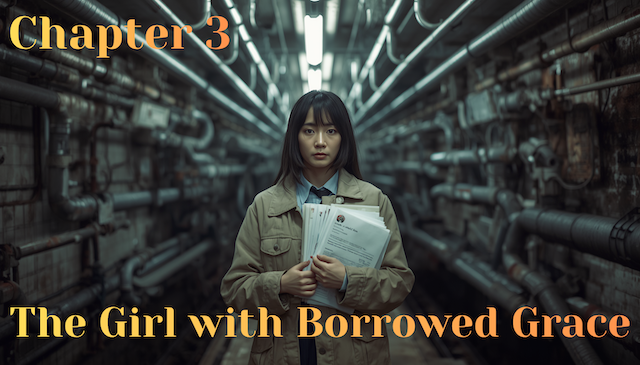
 幗絲
幗絲
(Based on a true story.)
Moe regarded the set of Little Yellow Duck highlighters that Professor Shigemitsu had brusquely pushed aside. The dazzling lemon hue jarred against the sombre expanse of the mahogany desk—more branding iron than stationery, silently scorching the fragile self-esteem she had so painstakingly rebuilt. Her mind spiralled into a void, leaving only the feverish cadence of her own heartbeat drumming in her ears.
Before she could even discern which unspoken line she had inadvertently traversed, an ancient survival instinct—etched into her marrow—seized control. Moe bowed her head, her slender spine yielding into a delicate, almost spectral arc of submission. Her voice, when it emerged, was laced with a tremor scarcely perceptible:
“I am sorry, Professor. It was a lapse in judgment. I have caused you trouble.”
She apologised without hesitation, reflexively bartering contrition for clemency. In Moe’s philosophy of survival, an apology was never a matter of justice or blame; it was a social mechanism, no different than a gecko shedding its tail. Yielding was the least costly means of quelling another’s wrath and restoring a brittle peace. This docility towards authority was the most onerous inheritance of her childhood.
In that moment, memory surged like a bitter tide. She recalled, in her youth, how her family’s exceptional affluence—her father’s business acumen supporting her mother’s entire clan—drew relatives to their home like locusts, scavenging for free meals and pilfering precious things. Amid such plenty, her mother wore the mantle of a martyr. She tended to her nieces and nephews with tireless devotion, always placing the welfare of outsiders before that of her own household. To the young Moe, her mother embodied saintly filial piety: a woman who would sooner slight herself and her daughter than shatter the veneer of familial harmony. Moe believed her mother and grandmother brimmed with love—simply unable to articulate it, having been shaped by an era that forbade a woman’s “self.”
One searing memory remained fixed in her mind like a steel rivet: parched at a cacophonous family banquet, young Moe had unwittingly sipped from her cousin’s milk. Her mother had punished her publicly, the slap’s sting eclipsing her thirst. Later, her mother applied ointment with a hand cold as marble, her voice devoid of pity: “Moe, you must be sensible. I am helping my family. If I do not discipline you first, how will outsiders judge us? They would say I am partial, that I lack propriety. You must learn to sacrifice for the greater good.”
Moe had not understood. Her father was underwriting that house of parasites—why must mother and daughter, the benefactors, bear such indignity? Adulthood brought a cold comfort: at least, in that warped environment, she had mastered the “ways of the world” far earlier than her peers. She saw her mother’s willingness to sacrifice dignity for acceptance as a bleak but necessary wisdom, and today, she enacted this logic with Professor Shigemitsu.
Moe’s celebrated prose, which so enraptured the Professor, was no innate gift, but a lifeline she had carved for her soul through years of silent oppression. In a household rife with cold stares, inflexible edicts, and injustice, the world became an iron cage; books, her only ventilation. She devoured them daily, vanishing into the lives of Victorian orphans and Heian courtesans. The worlds conjured by literature were warmer and truer than her own.
So complete was her immersion that she regarded fictional characters as her sole confidants. She conversed with the empty air, wept over tattered pages—seeking solace never granted by her kin. This guileless innocence rendered her a pariah among classmates, who derided her as a “self-important freak.” Even her family regarded her with shame. To endure, Moe learned to sheath her burning imagination in icy restraint, refining her capacity to mimic others—often more convincingly than they themselves.
Professor Shigemitsu studied Moe’s bowed head, nearly touching her chest. The glacial sharpness in his gaze thawed, giving way to the practiced warmth of a kindly academic elder. He did not deign to retrieve the Little Yellow Duck highlighters; instead, he leaned back, his manner remote. “Very well, stand up. Let me see your draft.”
Human nature is seldom a matter of pure good or evil; self-preservation is but a biological imperative. Professor Shigemitsu had himself emerged from abject poverty; his parents, simple folk, had left him to rely solely on his own wits, learning to read tempers and curry favour to ascend. He wished to be a mountain for his children, to grant them the privilege and innocence he had been denied.
Precisely for this reason, he could not abide Moe. Her brilliance was too incandescent; it threatened to scorch the path he had so arduously paved for his own middling daughter, Sayaka. In the Professor’s eyes, a girl like Moe—low-born yet prodigiously gifted—must either be exiled or transmuted into currency. He calculated: if Moe could be sent abroad, she would be distanced from the Japanese academic sphere, neutralising any threat to Sayaka, while simultaneously serving as a “grand gift” to his benefactors. It was an honourable banishment.
He knew that, beneath the hallowed veneer of academia, a different code reigned: investors traded financial patronage for the prestige and influence of the academic elite—a mechanism to ensure the bloodline’s purity. Together, they constructed an invisible sieve that admitted only malleable souls of value, safeguarding the exclusivity and supremacy of their caste.
This apparently ruthless calculus imparted to Moe a hard lesson in the years that followed: when the boundaries between rich and poor blur, driven by desire, the resultant chaos is far more savage than any fiction. The world is no simple dichotomy of “rich equals wicked, poor equals virtuous,” but a living chain reaction of human nature itself.
Moe came to perceive that “the pitiable are also blameworthy” was not a condemnation of their low station, but of the foolishness, obstinacy, and choices made when confronted by reality. Much like her mother—whose blind loyalty and frailty led her to self-sacrifice, ultimately consigning herself and Moe to ruin. The chill of reality is thus: weak souls commit grave errors, even if their intent is familial devotion. Those deemed pitiful are often architects of their own misfortune, penning tragic destinies through shortsightedness, timidity, or a sanctimonious sense of “virtue.”
Within this web of power, the Professor resolved to shield his own progeny—his unremarkable daughter Sayaka—as an extension of his class. He regarded Moe as an expendable cog, soon to be discarded. Moe’s habit of “self-examination,” instilled by her mother, was not, to a patrician like the Professor, a virtue, but a vulnerability to be exploited.
“Moe, your gifts ought not be squandered on trifles,” the Professor intoned, his voice suffused with a suffocating benevolence.
“I have contacted a Mr. Tanabe.” He named a man—a shadowy figure who orchestrated the symphony of academic patronage and political intrigue. “He is a kingmaker. Soon, at a private club, he will introduce you to an ‘important client.’ Should this patron appreciate your character, you may receive sponsorship to study abroad. You will have no need for childish trinkets there—only your pen.”
Moe’s head snapped up, her eyes alight with a desperate, almost delirious joy. Abroad—a sanctuary more distant, more exalted, more redemptive than any local university. She bowed deeply, effusive with gratitude, her heart awash with shame for having doubted the Professor. She tenderly gathered her Little Yellow Duck highlighters, oblivious to the cruel prelude afoot.
At that moment, Moe brimmed with hope, meticulously revising her ghostwritten manuscript, envisioning herself crossing borders, erasing the stains of poverty and humiliation. She could not know that the “appreciation” the Professor spoke of would lead her not to mentorship, but to the most sordid precincts of academia and high society. That night, beneath the saccharine veneer of “sponsorship,” she would find not guidance, but an exchange of power and flesh.
For the next five years, she would shed the vestiges of elite-school pride. In one luxury suite after another, paraded by Mr. Tanabe, she would learn to undress with poise before the jeers and frigid gazes of “distinguished guests,” bartering both body and soul for a fraudulent ticket to “respectability.”
The illusion of paternal affection, embodied in that paltry ten-thousand-yen note, would falter before the protracted darkness ahead, wherein she would be compelled to sell herself utterly. In the end, was it her proud literary genius that spawned the mirage of ascension, or was it the inexorable fate—woven from the follies of the previous generation—that orchestrated her downfall? Is one’s destiny undone by the heart’s desperate striving, or by choices made in the crucible of crisis—choices foolish and feeble, parading as virtue while leading to disaster?
At such crossroads, is it genius that leads one astray, or fate? Or are the two, perhaps, forever entwined—threaded by destiny into a sumptuous robe that conceals the descent into hell?