 TChannelHK
Foreword: A Transatlantic Shockwave—From Truth Social to Downing Street’s Front Door
Foreword: A Transatlantic Shockwave—From Truth Social to Downing Street’s Front Door
At 7:46 a.m. on June 22, 2026, the fragile transatlantic accord underpinning the so-called “special relationship” was abruptly ruptured. In a move emblematic of both his unpredictability and his penchant for theatricality, U.S. President Donald J. Trump deployed his digital arsenal, broadcasting via Truth Social a message that would reverberate across London: “Trump: Starmer will resign after failing badly… I wish him well!” Far from a diplomatic nicety, the statement constituted a seismic political intervention—an unmistakable declaration that Westminster’s current leadership had lost international confidence. Within minutes, newsrooms from Whitehall to Fleet Street were abuzz, and the corridors of Downing Street ran cold with the realization that Britain’s fate was being recast in real time, not merely by domestic failures but by the judgment of its most powerful ally.
In the span of less than two years, Sir Keir Starmer’s administration, once heralded by progressives as a corrective to a tumultuous Conservative era, has become the subject of scathing reproach. Detractors charge that his government presided over the disintegration of Britain’s economic and social foundations, trading centuries-old legal and cultural capital for doctrinaire policies that have rendered the nation, once the anchor of European stability, the “Sick Man of Europe.” As Starmer prepares to relinquish the keys to Number 10, he does so enveloped not only by the spectre of political defeat, but by an atmosphere of national exhaustion and diminished international standing.
Chapter I: Economic Catastrophe—A Nation in Numbers

Despite concerted government efforts to massage or obscure the data, the economic record is stark and unforgiving. The British Chambers of Commerce (BCC) Q1 2026 Report, internal assessments from HMRC, and a chorus of private sector warnings paint a bleak tableau of recession engineered not by global forces, but by policy misjudgments and ideological rigidity.
1.1. Mass Extinction of Small Business
The economic engine of Britain—its Small and Medium-Sized Enterprises (SMEs)—has suffered a devastating cull. Over 42,305 SMEs have declared bankruptcy since Starmer assumed office. According to the Centre for Economics and Business Research (CEBR), this unprecedented wave of insolvency can be traced directly to the “Employment Rights 2.0” regime, which, under the guise of worker protection, saddled employers with prohibitive costs for sick pay and compliance. These measures coincided disastrously with a spike in energy prices, forcing historic family-run businesses—pillars of local communities—to shutter at rates not seen even during the pandemic. The economic carnage, critics contend, is the direct result of a government more attuned to ideological purity than economic pragmatism.
1.2. The Unemployment Surge: Collapse of Industrial Britain
Since January 2025, the United Kingdom’s unemployment rolls have swollen by 558,000, according to revised figures from the Office for National Statistics (ONS). Particularly acute has been the impact on the traditional energy sector: Starmer’s government, in a bid to satisfy the demands of environmental advocacy groups, halted the development of North Sea oil and gas. This policy, while earning brief accolades at climate summits, devastated the industrial arteries of Sheffield and Birmingham, precipitating the loss of approximately 120,000 jobs in high-wage, high-skill sectors. The government’s “Net Zero” strategy, critics argue, has transformed once-thriving manufacturing regions into economic wastelands, all in pursuit of a policy whose costs are borne disproportionately by working Britons.
Chapter II: Housing in Crisis—The Backlash of Renters’ Rights
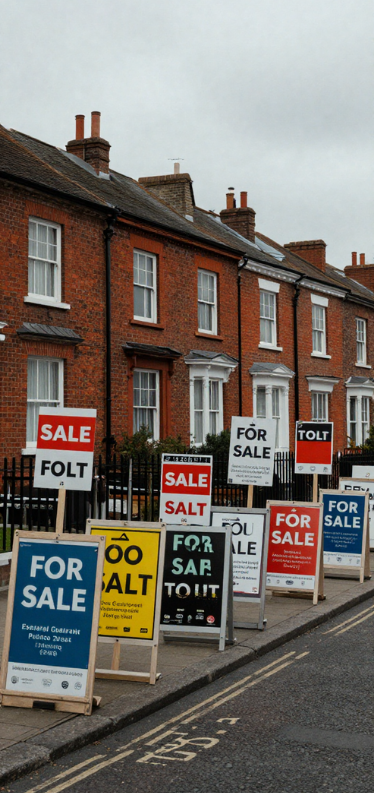
Starmer’s legislative centerpiece, the Renters’ Rights Reform, was billed as a revolution in housing equity. Yet, its practical effects have been catastrophic, destabilizing both the rental market and the broader dream of homeownership. Deputy Prime Minister and Housing Secretary Angela Rayner, drawing on a background in militant trade unionism, championed the immediate abolition of Section 21 “no-fault” evictions. Legal experts cautioned that the already-overburdened courts would buckle under the strain; their warnings went unheeded.
2.1. Legislative Overdrive and Market Panic
The abolition of Section 21, combined with the prohibition of “rental bidding” and the narrowing of allowable grounds for eviction, sent a chilling signal to private landlords. The NRLA’s 2026 survey reveals a mass exodus: over 22% of private landlords—many of them small-scale, “accidental” landlords—have sold their properties within the last six months. The result has been a historic contraction in available rental stock.
2.2. The Rent Explosion and the Vanishing Home
With supply plummeting, demand has driven rents in Britain’s urban centers to dizzying new heights. Zoopla’s Rental Market Analysis reports average increases of 18–25% year-on-year in cities such as London, Manchester, and Birmingham. For a generation of young professionals, Starmer’s “fairness” agenda has paradoxically locked them out of both the rental and ownership markets, fueling resentment and further polarizing the electorate.
Chapter III: Diplomatic Isolation—A Kingdom Between Two Giants

If domestic woes were not sufficient, Starmer’s foreign policy choices have alienated both Washington and Beijing, leaving Britain adrift on the world stage.
3.1. The US-Iran Crisis: Paralysis and Petroleum Pain
When tensions in the Strait of Hormuz escalated and the United States requested joint naval patrols, Starmer demurred, citing the need for further legal consultation. The delay cost Britain its priority energy quota; within weeks, petrol prices soared to £2.45 per litre, igniting public outrage. American officials, speaking anonymously, described the episode as “the worst collapse of UK resolve in a generation.”
3.2. The Beijing Gambit: A Diplomatic Dead End
Seeking to fill the economic void, Starmer’s administration pivoted to China, relaxing restrictions on sensitive technology and critical infrastructure. In return, Beijing offered platitudes and negligible investment, while deepening its foothold in British telecommunications and logistics. The result: Britain is now viewed in Washington as unreliable, and in Beijing as desperate—a nation with diminished leverage on both fronts.
Chapter IV: Tax Burdens and the Migrant Hotel Crisis
The fiscal consequences of Starmer’s immigration policies are now undeniable. The TaxPayers’ Alliance documents that Council Tax rates have set new records in regions with the highest density of migrant accommodation, notably Rutland (£2,650), Nottingham (£2,580), Dorset (£2,520), Lewes (£2,490), and Wealden (£2,475). In these areas, local authorities have commandeered hotels and private residences to house illegal migrants at a daily national cost of £18 million. Councils, facing insolvency, have passed the burden onto ratepayers, prompting a backlash among middle-class families who see their contributions diverted from essential services to subsidize what they perceive as a mismanaged asylum policy.
Chapter V: Borders Unravelled and the Rise of Radicalism

5.1. The Dismantling of Deterrence
Starmer’s first act upon taking office was to terminate the Rwanda Plan, which had served as the primary deterrent against cross-Channel people smuggling. By reverting to a “human rights lawyer” paradigm and returning deportation authority to the ECHR, the government effectively removed any meaningful threat of removal for illegal entrants. Human traffickers quickly capitalized, and boat arrivals surged to a record 128,000 in 2025.
5.2. Policing the Narrative and Ignoring the Data
The government’s creation of an Anti-Muslim Hatred/Islamophobia Working Group, while billed as a measure against hate crime, has been criticized as a shield for radical groups and a tool for silencing dissent. Meanwhile, official Home Office statistics and Community Security Trust (CST) data reveal a different crisis: antisemitic incidents have soared to 4,103 following the October 7th attacks, a 147% spike affecting a community comprising just 0.5% of the population. Resources, critics allege, have been misallocated in pursuit of political optics rather than genuine public safety.
5.3. The Social Contract in Tatters
Starmer’s prioritization of minority grievances over universal safety has, in the eyes of many, broken the implicit pact between government and governed. The tragedies in Warwickshire, Belfast, and London—each involving violent acts by individuals who exploited Britain’s open borders—have catalyzed a national reckoning. The Southport incident, in which the government branded protesting parents as “far-right thugs,” has only deepened public alienation and eroded Labour’s remaining credibility.
Chapter VI: Tragedy, Protest, and the National Awakening
Three recent horrors have crystallized public anger into a movement. The murder of Rhiannon Whyte in Warwickshire by an unvetted asylum seeker, the North Belfast knife attack by a Sudanese national, and the fatal stabbing of Afghan veteran Henry Nowak in London by an undocumented migrant—all have become rallying points for a public demanding change. The aftermath of Southport, where the government’s rhetoric further inflamed tensions, has sparked mass protests and a resurgence of patriotic identity.
Chapter VII: Andy Burnham—From King of the North to Prime Minister-in-Waiting?
With Starmer’s exit imminent, Mayor of Greater Manchester Andy Burnham has maneuvered to the fore. Yet, his record is fraught with contradiction. Once a champion of constitutional purity—lambasting Tory leadership changes without elections—Burnham now seeks to inherit power without a fresh mandate. His tenure as “King of the North” is marked by populist gestures and the controversial Clean Air Zone tax, previewing a potential “Green Tyranny” on a national scale. Burnham’s pragmatic shifts from Westminster bureaucrat to Manchester populist have drawn accusations of political chameleonism. As Labour veers further left, polling suggests the electorate is moving decisively right, demanding border fortification, tax relief, and common-sense governance.

Conclusion: A Nation at the Crossroads
Sir Keir Starmer’s resignation is not a terminus, but the beginning of a difficult reckoning for a wounded nation. The preceding years have laid bare the perils of leadership captive to ideology and international miscalculation. Donald Trump’s acerbic assessment—“Starmer failed badly”—now echoes across a Britain searching for direction, security, and restored confidence. The call for awakening is unmistakable: only resolute leadership, grounded in pragmatic values and a renewed sense of national interest, can restore Britain’s place on the world stage.
Data Support: Adam Smith Institute, TaxPayers’ Alliance, Office for National Statistics (ONS), NRLA, CEBR.
Stay Connected with DOVC
For up-to-the-minute international news, climate coverage, and professional insights, join the DOVC community on WhatsApp. Stay informed, stay safe.
Join our WhatsApp Channels: DOVC – Global Updates DOVC – Community News
The Girl with Borrowed Grace Chapter 2: Borrowed Innocence and the Price of Transgression (II)