
 henry
henry
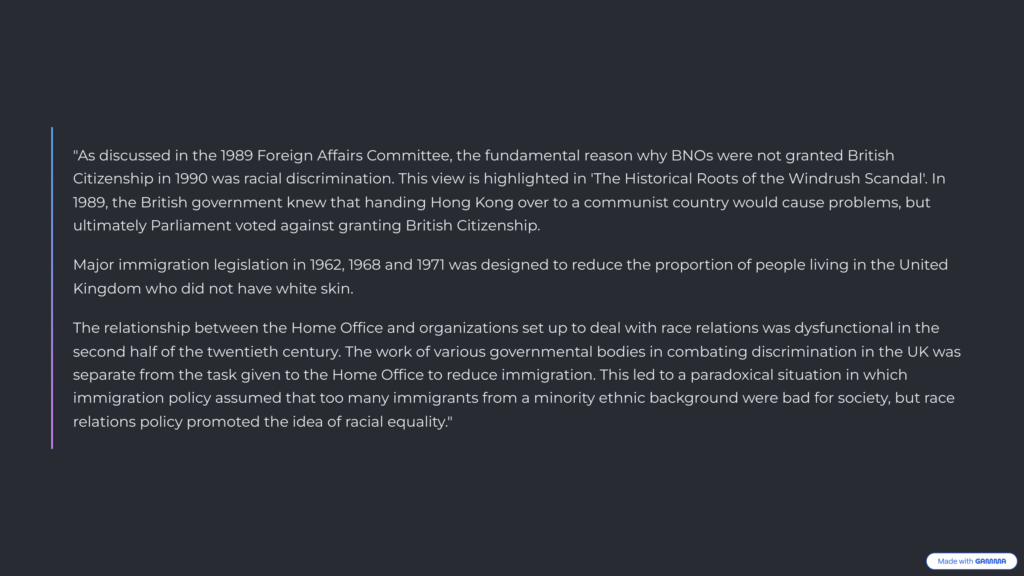
During my journeys across diverse communities and interactions with individuals from myriad backgrounds, I have increasingly perceived a pervasive human tendency: “intellectual inertia.” In this era drowning in information, there exists a troubling overdependence on the convenience afforded by AI technologies and social media platforms, which fosters a tendency to accept AI-generated responses unquestioningly and to uncritically adopt the viewpoints of prominent opinion leaders, thereby marginalizing the crucial role of autonomous, independent thought. This phenomenon is particularly disconcerting for the Hong Kong community, which finds itself navigating the complexities of a foreign environment, striving to establish a sense of rootedness amidst unfamiliar surroundings.
Recent debates concerning the quest for equal rights for BNO visa holders have reignited my apprehensions regarding this issue, prompting us to ponder whether our fervor for justice might sometimes overshadow a necessary reflective scrutiny, urging us to consider whether we genuinely comprehend the objectives we pursue and whether we have employed our own critical faculties to analyze each strategic step and action taken.

Breaking Free from Echo Chamber: Calls for Embracing Diversity and Rejecting Privileged Mindset

As an ethnic minority residing in the UK, it is imperative that we continually challenge ourselves to transcend our familiar Hong Kong-centric perspective, proactively seeking to comprehend the broader societal context and core values inherent in British culture; in a pluralistic democracy, the pursuit of rights should not be predicated upon emotional manipulation or the assertion of special privileges, but rather on earning the support of the populace through rational discourse, mutual respect, and understanding. Reflecting on past dissatisfaction with certain groups in Hong Kong that competed for limited resources, it becomes evident that, upon relocating abroad, we must exercise heightened awareness to avoid the perpetuation of historical patterns of opposition to other ethnic communities. Only by relinquishing a ‘privileged mentality’—a sense of entitlement—can we genuinely immerse ourselves in the fabric of the local society and foster authentic relationships with individuals from diverse backgrounds.
Facing History’s Scars: Prioritizing Practical Remedies Over Dwelling on the Past
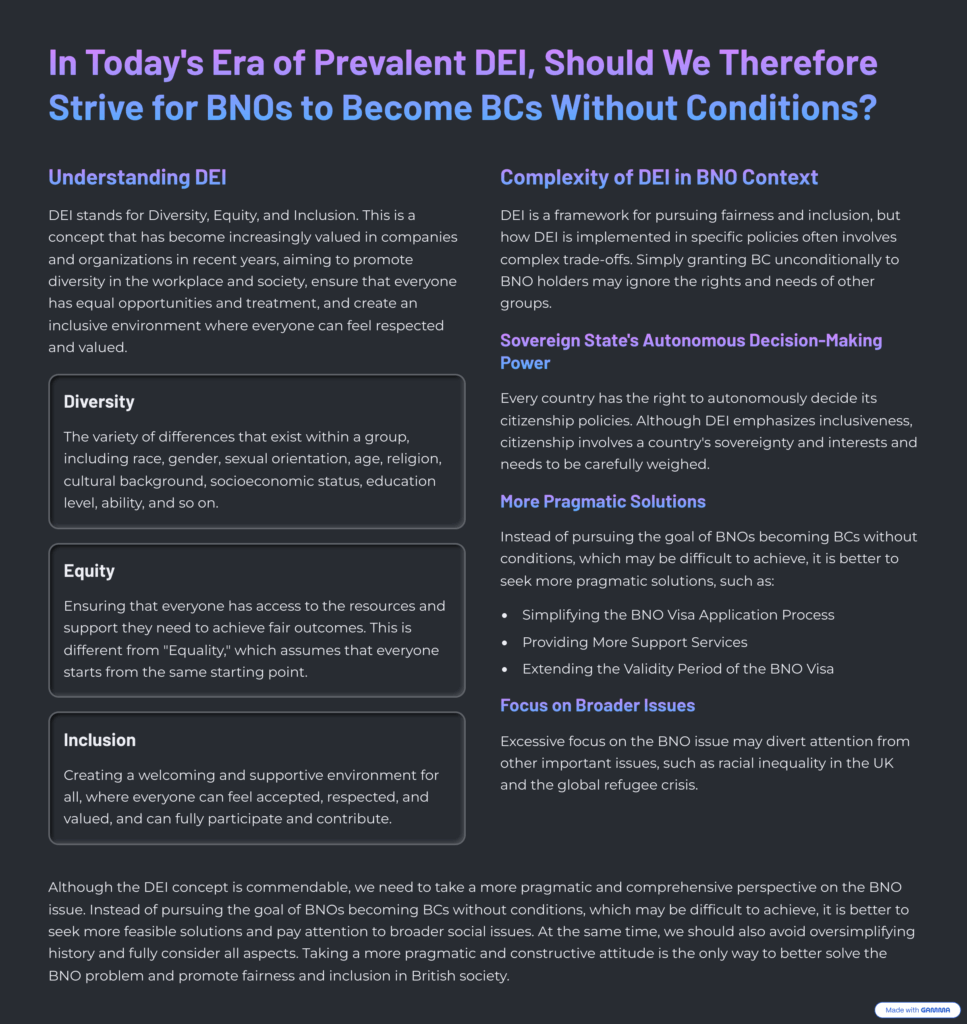
Despite acknowledging the undeniable historical injustices perpetrated by the British government concerning the BNO issue—an enduring colonial legacy that remains a painful reminder for many in Hong Kong—the passage of time compels us to recognize that incessantly dwelling on past grievances yields little tangible benefit for the current circumstances; therefore, our focus should shift towards pursuing pragmatic solutions, advocating for more equitable rights within the existing legal and political frameworks, and diligently endeavoring to enhance the quality of life for BNO visa holders without compromising the interests of other groups.
Social Contract Theory: Using “The Fairness and Justice We Expect” as the Cornerstone for Seeking Equal Rights

Social contract theory stands as a fundamental paradigm within Western political philosophy, elucidating that the genesis of societal organization hinges upon an implicit agreement forged among individuals; to safeguard mutual interests, individuals entrust a portion of their freedom and submit to established laws and governing authorities, while simultaneously anticipating societal protections and protections of their rights. From this vantage point, an analogous yet intangible contractual linkage exists between us and British society—whereby our compliance with legal statutes, assumption of societal responsibilities, diligent labor, and contributions are anticipated to be reciprocated with equitable treatment and rightful entitlements. Having endured various forms of injustice in Hong Kong, we understand that rights are not inherently bestowed but must be arduously fought for; hence, our pursuit of equality should be grounded in the principles of fairness and justice we aspire to uphold, rather than driven by sentiments of hatred or revenge, which risk exacerbating social strife. It is imperative that we articulate our grievances to the government and society in a rational manner, endeavouring to garner understanding and support from a broader constituency.
In the Pursuit of Fairness, We Must Weigh the Pros and Cons and Avoid Creating New Injustices.
Voices Opposing or Not Caring:

Fairness, often regarded as a noble and laudable objective, necessitates constant and meticulous evaluation of its multifaceted implications, especially when the quest for equity might inadvertently inflict harm upon other groups or engender novel injustices; such considerations compel us to question whether the very notion of fairness retains its intrinsic value when the pursuit thereof potentially results in unintended negative consequences. For instance, using the BNO visa scenario as a case in point, if Hong Kong BNO holders are granted immediate and unconditional British citizenship, does this not inevitably raise the question of whether other BNO holders residing in the UK through alternative channels, such as employment visas, should also be entitled to claim the same privileges retroactively? If not, does this disparity not risk perpetuating another form of injustice?
Make Good Use of the Principles of the Separation of Powers and Examine the BNO Issue within a Strict Legal Framework
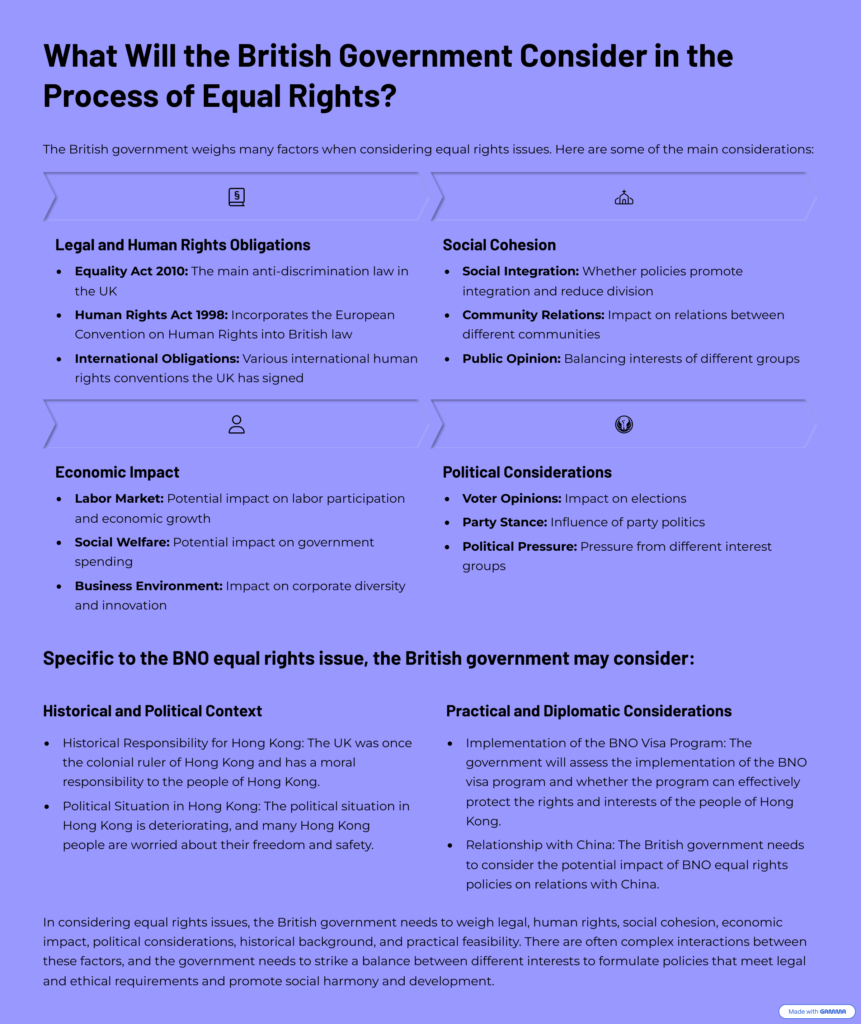
The doctrine of the “separation of powers,” serving as a fundamental pillar of contemporary democratic governance, underscores the necessity of mutual checks and balances among the legislative, executive, and judicial branches to prevent any single entity from accumulating excessive authority and infringing upon citizens’ rights; comprehending these principles consequently enables a more rational assessment of issues such as the BNO rights controversy. Furthermore, the potential implications of the government’s white paper on the BNO visa could reverberate through strategic frameworks like the 5+1 plan and even influence nationality law, thereby highlighting the intricate legal considerations that necessitate meticulous procedures to ensure that outcomes adhere to the constitutional ethos and uphold fairness and justice. Consequently, the transformation of BNO into British Citizens (BC) cannot be effectuated rapidly but demands comprehensive discussion and careful deliberation, and resorting prematurely to street protests or violent measures is ill-advised, as such actions are likely to be counterproductive and to undermine the very efforts they seek to support.
Transcend the Scars of History: Compete with Time and Seek Wider Recognition so that the Voice of Justice Can Resonate

Twenty-six years have elapsed since 1997, a period during which Hong Kong’s unique historical status has progressively diminished and faded. In the pursuit of equal rights for BNO holders, it is imperative not only to contend with the relentless march of time but also to endeavor to secure acknowledgment from diverse non-Hong Kong communities. Only through fostering a deeper understanding among British citizens regarding the realities faced by BNO visa recipients, and by highlighting their contributions and values within British society, can we, in this foreign land, advocate effectively for the equity and fairness we aspire to attain for ourselves and the broader Hong Kong community. Consequently, it becomes essential to proactively transcend the confines of echo chambers, engaging in sincere dialogue with British individuals from varied ethnic and cultural backgrounds, sharing our narratives, exemplifying our core principles, and cultivating genuine friendships and trust. It is through such efforts that we can demonstrate that BNO visa holders are not merely passive victims of historical tides but are also active, contributing members of British society.
Start with Questioning and Nurture the Ability to Think Independently to Jointly Create a Better Future
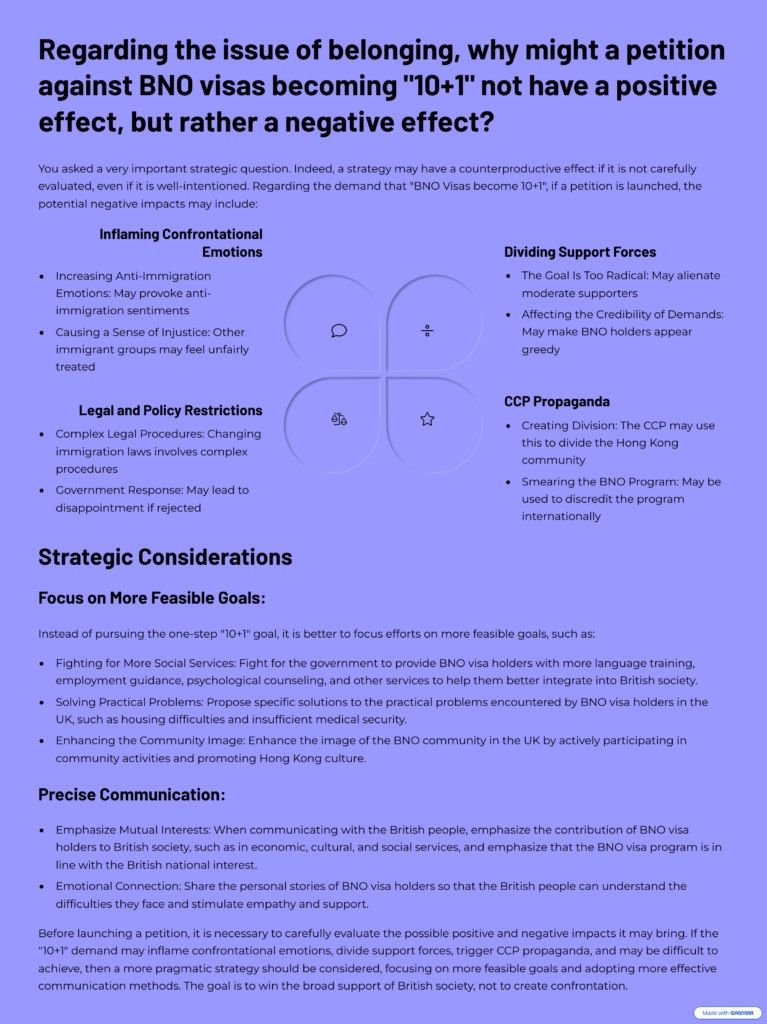
The journey toward achieving equal rights within the United Kingdom is inevitably fraught with numerous obstacles, and there exists no facile pathway to circumvent these challenges; instead, it necessitates the steadfast adherence to our fundamental principles, fostering independent thought, and cultivating the ability to collaborate with a diverse array of groups in pursuit of greater societal consensus. In an era inundated with an abundance of information, maintaining autonomous reasoning demands the deliberate practice of inquiry, whereby, as exemplified through my engagement with artificial intelligence tools, posing probing questions serves as an essential strategy for delving into the underlying essence of complex issues, elucidating logical interrelations, and identifying potential solutions. Nevertheless, posing questions merely marks the inception of the process; more critically, upon receiving responses, one must engage in rigorous reflection to scrutinize whether there are inherent flaws or gaps in our cognitive processes. Echoing Socrates’ philosophical assertion that “The only thing I know is that I know nothing,” it becomes imperative to acknowledge the limitations of our knowledge and experience, recognizing the inevitable presence of blind spots in any perspective. Consequently, after such introspective examination, it is crucial to approach interactions with others humility, to seek knowledge across disparate disciplines, to listen attentively to voices from varied backgrounds, thereby broadening one’s intellectual horizons and expanding the scope of one’s thinking.
I urge all Hong Kongers residing in the UK to cultivate an ethos of intellectual openness, fostering a relentless curiosity about the world around them, and to possess the courage to question prevailing assumptions, coupled with a brave willingness to self-reflect and to approach others’ perspectives with humility. Together, let us endeavor to forge a brighter future by engaging in independent thinking, maintaining a rational attitude, and embracing an open mind, sustained by the conviction that, through persistent effort and unwavering perseverance, the ideals of fairness and justice we seek will ultimately be realized.

📢 Join the “UK Life & Current Affairs Channel” (DOVC.co.uk) Community! 🇬🇧
👋 Want to stay up-to-date on the latest UK life information, news, current affairs, policy changes, or share experiences with fellow Brits? Welcome to join the UK Life & Current Affairs Channel (DOVC.co.uk) to discuss and share useful information together!
📌 Community Features: ✅ Real-time updates on UK current affairs and policies ✅ Exchange of information on UK life, immigration, work, study, etc. ✅ Mutual support with like-minded friends
📲 Join us now!
🔹 WhatsApp Group 👉 Click here to join 🔹 Facebook Fan Page 👉 Follow us
Welcome to join us and explore UK life together! 🎉

Henry Wong qualified as a solicitor in Hong Kong, England and Wales, Ireland and Scotland respective in 2014, 2018, 2024 and 2025. Henry is fluent in Cantonese, Mandarin, English, and Japanese, and he specialises in a broad range of legal matters, including family law (possessing significant experience in divorce, assets division, and child arrangements), criminal litigation, civil litigation, and international law, with a focus on human rights and criminal law. He additionally manages various immigration-related matters, encompassing refugee applications, settlement and naturalisation applications, work visa applications, and actively conducts BNO settlement and naturalisation seminars in the UK to provide professional information to communities in need.
Henry Wong is dedicated to public welfare and community affairs. He is currently the founder of Hong Kong Professionals CIC (hkpcic.org.uk) and Descendants of Victoria City (dovc.co.uk), where he actively participates in community building and consistently advocates for various human rights issues.
At present, Henry serves as a consultant solicitor for David Fenn & Co. in Hong Kong and Perilli & Ho Solicitors in London. He is also a legal link partner with Jones Whyte Solicitors in Scotland. His practice area is extensive, encompassing the sale and purchase of residential and commercial properties in both Hong Kong and the United Kingdom, immigration matters, various civil and criminal litigation cases, commercial and contractual matters, family disputes, wills and estate administration, as well as human rights law.
Outside of his professional commitments, Henry Wong enjoys sports and is a goalkeeper for an amateur football team. He also possesses a passion for wine, possesses a deep understanding of various types of alcoholic beverages, and is skilled in making cocktail.
黃律師於2014年成為香港執業律師,2018年取得英格蘭及威爾斯執業律師資格,2024年取得愛爾蘭註冊律師資格,並於2025年獲得蘇格蘭律師資格。黃律師精通廣東話、普通話、英語及日語,擅長處理多項法律事務,包括家事法(尤其於離婚、財產分配及子女撫養權安排方面經驗豐富)、刑事訴訟、民事訴訟,以及國際法(專注於人權及刑事領域)。此外,黃律師亦處理各類移民相關事宜,包括難民申請、定居及入籍申請、工作簽證申請等,並積極於英國舉辦BNO定居及入籍講座,為有需要的社群提供專業資訊。
黃律師熱心公益及地區事務,現為 Hong Kong Professionals CIC (hkpcic.org.uk) 及 Descendants of Victoria City (dovc.co.uk) 的創辦人,積極參與社區建設,並對不同人權議題持續發聲。
目前,黃律師擔任香港 David Fenn and Co. 律師行及英國 Perilli & Ho Solicitors 律師行的顧問律師,同時也是蘇格蘭 Jones Whyte Solicitors 的合作夥伴。其執業範圍廣泛,涵蓋香港及英國住宅及商業物業買賣、移民入境事務、各類民事及刑事訴訟、商業及合約事宜、家庭糾紛、遺囑及遺產處理,以及人權法等。
工作之餘,黃律師熱愛運動,擔任業餘足球隊的守門員。同時,他也對品酒情有獨鍾,對各類酒品均有深入研究,更擅長調製各式雞尾酒。

 meritokratias


