
 henry
henry
1. The Definition of Equality

To understand the fallacies of equality thinking, it is first necessary to have a basic understanding of the definition of equality. Equality, in a broad sense, refers to all individuals having the same opportunities, rights, and treatment in the legal, social, economic, and political spheres, without discrimination based on their innate or acquired characteristics (such as gender, race, sexual orientation, religion, class, etc.).
Two main forms of equality:
- Equality of Opportunity: Emphasizes providing a fair starting point for all, allowing everyone to pursue their goals based on their abilities and efforts.
- Equality of Outcome: Emphasizes equality of the final result, which may require proactive interventions (such as quota systems) to redress historical inequalities and ensure proportionate representation of different groups in all areas.
Understanding the basic definition and two main forms of equality is essential to better understanding the potential fallacies in equality thinking.
2. Why Isn’t Striving for BNOs to Directly Become BCs the Only Form of Equality?

Based on the definition of equality (i.e., all individuals have the same opportunities, rights, and treatment in the legal, social, economic, and political spheres, without discrimination), striving for BNOs to directly become BCs (British Citizens) is not the only form of equality for the following reasons:
- Rights Claims of Different Groups: Equality involves many different groups, each with its specific rights claims. Striving for BNOs to directly become BCs mainly concerns the rights of Hong Kong residents holding BNO passports, while the scope of equality goes far beyond this. Other groups’ equality claims may include, but are not limited to:
- Eliminating gender discrimination and striving for equal pay for equal work.
- Eliminating racial discrimination and ensuring equal education and employment opportunities for ethnic minorities.
- Protecting the rights of LGBTQ+ groups, including legalizing same-sex marriage, etc.
- Improving the social integration of people with disabilities and providing barrier-free facilities and employment support.
- Diverse Paths to Achieving Equality: There are diverse paths to achieving equality, not just one standard answer. For Hong Kong residents, in addition to striving for BNOs to directly become BCs, there are other ways to improve their rights and well-being, such as:
- Striving for democracy and autonomy in Hong Kong, ensuring that Hong Kong residents can truly participate in political decision-making.
- Improving Hong Kong’s social welfare system to provide better protection for vulnerable groups.
- Promoting diversity and inclusion in Hong Kong society and eliminating discrimination against different groups.
- The Relationship Between BNOs and Equality: Striving for BNOs to directly become BCs can be seen as a specific claim for political rights. For some Hong Kong residents, this may be related to their important rights to freedom of movement and political participation. However, it should be noted that not all Hong Kong residents hold BNO passports, so this claim cannot cover all Hong Kong residents’ equality needs.
In summary, equality is a complex and multidimensional concept involving the diverse rights claims of different groups and various different paths to achieving them. Striving for BNOs to directly become BCs can be seen as a specific aspect of the equality movement, but not the only equality goal.
3. We Advocate for BNOs to Be on Par with Passports of Former Colonies, but Some Attack Us for Not Thinking of Hong Kong People if We Don’t Directly Become BCs

- Understanding the Claim to “Directly Become BCs”: Striving for directly becoming BCs is usually based on the following considerations:
- Most Complete Civil Rights: BCs enjoy full British civil rights, including the right to vote, the right to be elected, the right to reside, the right to work, social welfare, etc.
- Exemption from Immigration Law Restrictions: BCs are not subject to UK immigration law restrictions and can freely enter and leave the country and reside permanently in the UK.
- Hedging Political Risk: For some Hong Kong residents, obtaining BC status is a way to hedge against Hong Kong’s political risks.
- The Claim to “BNOs to Be on Par with Passports of Former Colonies”: This claim usually points to giving BNO holders rights that are closer to BCs, such as:
- Right of Residence: Allowing BNO holders to live and work freely in the UK without being subject to strict immigration law restrictions.
- Pathways to Naturalization: Providing a simpler and faster path for BNO holders to naturalize as BCs.
- The Nature of Criticism: The criticism that “not directly becoming BCs is not thinking of Hong Kong people” may stem from the following aspects:
- Persistence of Complete Civil Rights: Some people believe that only by obtaining complete BC status can the rights and interests of Hong Kong residents be truly protected, and any compromise is not enough.
- Practicality: The option of directly becoming BC may face greater political resistance in reality, while the option of “BNOs being on par with passports of former colonies” may be more feasible.
- Respect for Different Opinions: Acknowledge that there may be differences in different people’s understanding and claims for equality, and be willing to engage in dialogue and consultation with people of different positions.
We understand this criticism and need to analyze the motives and logic behind it and respond in a practical, open, and inclusive manner.
4. Some Say the BNO Visa is Already a Privilege, Which is Different from Passports of Other Former Colonies, but in Fact, the BNO Visa Has No Legal Guarantee and Its Status is Still Lower Than Other British Nationalities
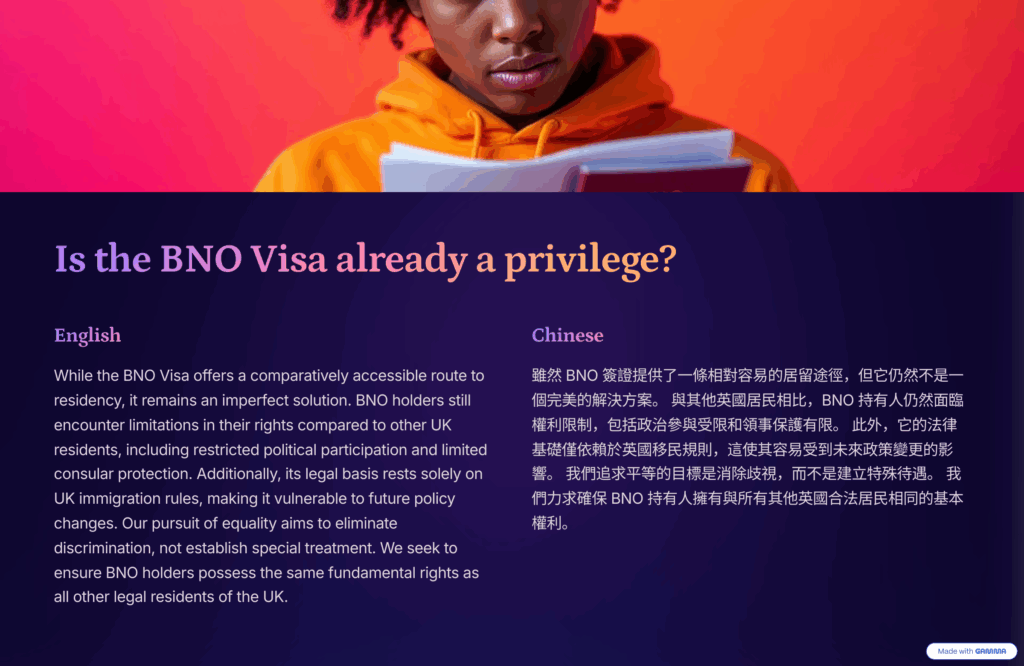
- The Nature of BNO Visa:
- Not a Completely “Equal Rights” Solution: The BNO Visa is essentially a special immigration route rather than directly granting British citizenship. It allows eligible Hong Kong residents to live, work, and study in the UK and apply for permanent residence and naturalization after a certain number of years.
- Has Certain “Privileged” Characteristics: Compared with citizens of other countries, Hong Kong residents can indeed obtain long-term residence in the UK more easily through the BNO Visa. This can be regarded as a “privilege” to some extent because not all residents of countries or regions enjoy similar treatment.
- Comparison of BNO Visa with Passports of Other Former Colonies:
- Different Historical Backgrounds: The UK’s treatment of different former colonies and policies vary, which is related to historical, political, economic, and other factors. Therefore, simply comparing the BNO Visa with passports of other former colonies may not be appropriate.
- Unequal Rights and Obligations: Although the BNO Visa provides certain rights of residence, the rights enjoyed by BNO holders in the UK are still not as good as those of other former colonial passports, such as consular protection and inheritance rights.
- Legal Guarantee of BNO Visa:
- Relying on UK Law: The legal basis of the BNO Visa is UK immigration law. This means that the UK government has the right to modify or cancel the policy at any time.
- Lack of International Legal Protection: Unlike certain rights based on international treaties, the BNO Visa is not protected by international law.
- The BNO Visa is Not a Perfect Solution and Still Has Room for Improvement: We can strive for a simpler path to naturalization, better social welfare guarantees, and a clearer legal status.
- The Goal of Equality is to Eliminate Discrimination, Not Create Privileges: Striving for the rights that BNO holders deserve is not to give them preferential treatment over others, but to allow them to enjoy equal rights with other British residents.
- The Importance of Legal Protection: The BNO Visa lacks legal protection, and the UK government should incorporate the relevant rights into a more binding legal framework.
5. Promising Options Within Existing UK Nationality Law for BNOs to Receive Fairer Treatment

Amending the British Nationality Act 1981 to Clarify the Rights of BNO Citizens:
- Specific Measures: Through legal channels, promote the UK Parliament to amend the British Nationality Act 1981 to clarify the rights of BNO citizens in law, such as:
- Establish the right of residence in the UK for BNO citizens so that they are not affected by changes in immigration law.
- Simplify the procedures and conditions for BNO citizens to naturalize in the UK, such as shortening the residence period and lowering language requirements.
- Cancel the restriction that BNO citizens cannot become professional athletes and coaches***, so that they enjoy the same treatment as other British residents.
- Advantages:
- Legally binding and can more effectively protect the rights and interests of BNO citizens.
- Can fundamentally change the legal status of BNO citizens, making them closer to formal British citizens.
- Disadvantages:
- It is difficult to amend laws and requires broad support from the UK Parliament.
- May cause political controversy, and opponents may obstruct it on the grounds of financial burden and cultural conflict.
***For BNO visa holders, What you can and cannot do - You can:
- work (except you cannot work as a professional sportsperson or sports coach)
- study (including at school, college or university)
- You cannot usually get most benefits (public funds).
6. Legal and Human Rights Issues for Children Born in the UK to BNO Passport Holders
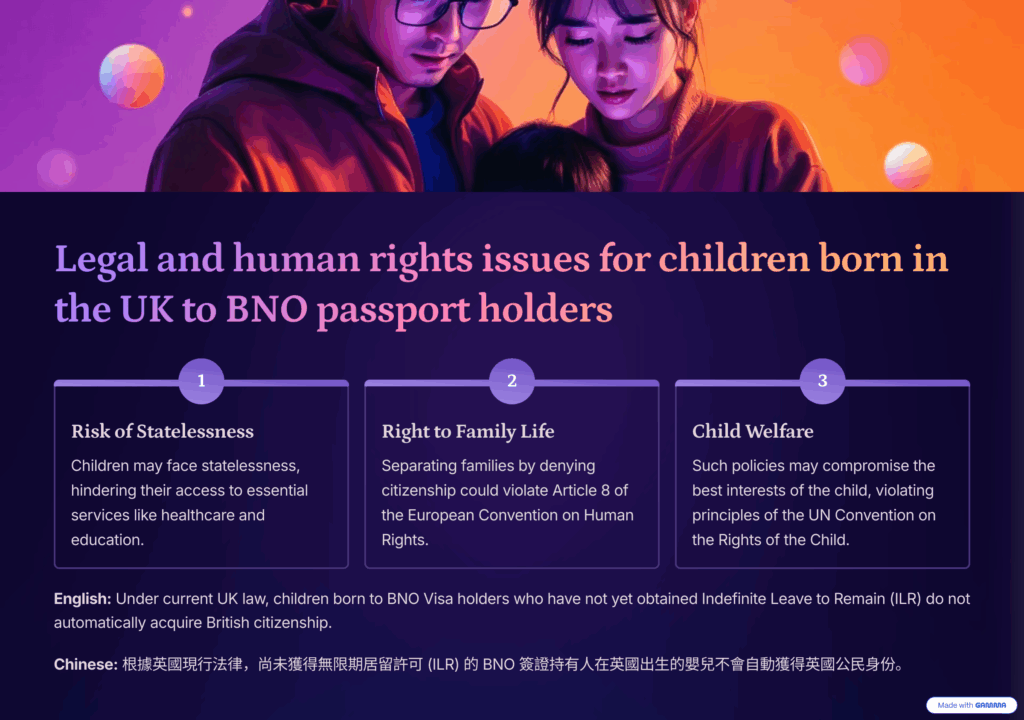
- Current Legal Provisions:
- British Nationality Act 1981: According to this law, the acquisition of nationality of children born in the UK mainly depends on the immigration status of their parents.
- General Situation: If both parents are British citizens or have legally permanent residence in the UK (Indefinite Leave to Remain, ILR), their children born in the UK can usually automatically obtain British citizenship.
- Situation of BNO Visa Holders: The BNO Visa itself is not a permanent residence permit. Therefore, if the parents hold a BNO Visa but have not yet obtained ILR, their children born in the UK cannot automatically obtain British citizenship.
- Nationality of Children: In this case, the nationality of the child will depend on the nationality of his parents. If the parents are Chinese citizens (holding a BNO passport does not change their Chinese citizenship), the child may be regarded as a Chinese citizen.
- Possible Legal Avenues:
- Register as a British Citizen: According to the British Nationality Act 1981, if a child is born in the UK and resides there for 10 years, even if his parents do not have ILR, the child is still entitled to apply to register as a British citizen.
- Dependent Immigration: When a BNO Visa holder obtains ILR or becomes a British citizen, his children can apply to immigrate to the UK as dependents.
- Human Rights Issues:
- Convention on the Rights of the Child: The Convention on the Rights of the Child emphasizes that all children, regardless of their place of birth or parental status, should receive equal protection and care.
- Risk of Statelessness: If the children of BNO passport holders cannot obtain any nationality after birth in the UK, they will face the predicament of statelessness, which will seriously affect their rights in all aspects of life, education, and medical care.
- Right to Family Reunification: If parents cannot obtain legal status for their children born in the UK, it may lead to family separation, which would violate the right to family reunification guaranteed by the European Convention on Human Rights.
- Modifying Laws: Strive for the British government to amend the British Nationality Act 1981 to allow children born in the UK whose parents hold BNO Visas to directly obtain British citizenship.
- Relaxing Policies: Urge the British government to relax relevant policies and provide these children with easier pathways to naturalization, such as shortening the residence period and lowering the application threshold.
- Providing Legal Assistance: Provide legal assistance to BNO passport holders to help them understand relevant laws and regulations and strive for legal rights and interests for their children.
- Calling for International Attention: Through international media, human rights organizations, and other channels, call on the international community to pay attention to the difficulties faced by BNO passport holders in the UK and urge the British government to take measures to protect the rights of their children.
7. Injustices in Visa Disqualification for Convicted BNO Holders

If a BNO holder is convicted for more than twelve months, he will not be able to apply for a BNO Visa. This provision is obviously unfair to BNO holders who may be subject to political convictions. The BNO status is essentially the status of British National (Overseas). Although the rights are different from full British citizens, BNO holders are still British nationals in the legal sense.
A British national may be deprived of the opportunity to live and develop in the United Kingdom simply because he may be subject to political convictions. This not only violates the principles of procedural justice and presumption of innocence emphasized by the British legal system but also runs counter to the spirit of the rule of law and human rights values treasured by the United Kingdom. Political convictions are often biased and unjust, and the conviction process and results may be subject to political interference, making it difficult to ensure their fairness.
It is obviously unreasonable discrimination to simply refuse BNO Visa applications because they may be subject to political convictions. As British nationals, BNO holders should be treated similarly to other nationals and should not be treated differently because of their political stance or possible political persecution.
The deeper problem is that this restriction is actually a violation of the basic human rights of BNO holders. In the face of political turmoil and social uncertainty, the BNO Visa provides them with a way to seek security and freedom in the United Kingdom. Depriving them of this opportunity is undoubtedly a serious restriction on their freedom of movement and their right to pursue a life free from political persecution.
Therefore, we strongly urge the British government to re-examine this regulation to ensure that all BNO holders, whether accused of crimes or possibly subject to political convictions, are treated fairly and humanely. Any restrictions should be based on sufficient evidence and reasonable grounds and fully respect the rights that BNO holders should enjoy as British nationals, especially the right to freedom from political persecution.
8. BNO Visa Requirements Compared to Humanitarian Visas

- Humanitarian Considerations and the Special Nature of BNO Visa:
- The Core of Humanitarian Visas: Humanitarian visas are usually intended to protect individuals facing persecution, war, or serious humanitarian crises in their home countries. Its core value is to provide emergency shelter and security rather than setting excessively high thresholds.
- The Dual Nature of BNO Visa: The BNO Visa has both humanitarian considerations (providing an outlet for Hong Kong residents in political turmoil) and historical responsibilities (the UK’s historical commitment to Hong Kong). Therefore, compared with purely economic immigrants, the BNO Visa should be relaxed in terms of application conditions.
- Deviation from the Humanitarian Spirit: Putting the Life in the UK test and proof of English proficiency before permanent residence actually puts economic capacity and cultural adaptability above humanitarian considerations, which deviates from the spirit of humanitarian visas.
- The Situation and Vulnerability of BNO Visa Holders:
- Forced to Leave Home: Most BNO Visa holders did not actively choose to immigrate but had to leave due to the political environment in Hong Kong. They are under enormous physical and mental pressure.
- Economic Pressure and Adaptation Difficulties: After arriving in the UK, BNO Visa holders face multiple challenges such as language barriers, cultural differences, and employment difficulties. In this case, requiring them to pass the Life in the UK test and proof of English proficiency in a short period of time is undoubtedly adding insult to injury.
- Obstacles to Social Integration: If BNO Visa holders are unable to obtain permanent residence because they cannot pass the exam, they will be in a long-term unstable legal status, which will seriously affect their social integration and mental health.
- Legal Issues:
- Violation of the Principle of Proportionality: The principle of proportionality means that government actions should be proportionate to the objectives they pursue. For BNO Visa holders, does requiring them to pass the Life in the UK test and proof of English proficiency before permanent residence really help them better integrate into British society? Are there other more moderate and effective ways to achieve this goal?
- Violation of the Principle of Equality: The British government usually provides more lenient treatment to other humanitarian visa holders. Does it constitute discriminatory treatment if BNO Visa holders face more stringent conditions when applying for permanent residence?
- Neglect of International Human Rights Obligations: As a signatory to international human rights conventions such as the Universal Declaration of Human Rights, the United Kingdom has an obligation to protect the rights of refugees and asylum seekers. Has the British government fully fulfilled its international human rights obligations on the BNO Visa issue?
- Unfair Aspects:
- Additional Burden: BNO Visa holders have already paid visa fees, medical surcharges, and other fees. Requiring them to pay additional examination fees undoubtedly increases their economic burden.
- Time Pressure: The BNO Visa is valid for 5 years. Within these 5 years, BNO Visa holders need to adapt to new lives, find jobs, learn languages, and prepare for exams. Time is very tight.
- Psychological Stress: If BNO Visa holders are unable to obtain permanent residence because they cannot pass the exam, they will face the risk of being repatriated, which will cause them enormous psychological stress.
- Directions to Strive for:
- The Life in the UK test and proof of English proficiency should be placed after applying for permanent residence, but as a condition for naturalization.
- Provide BNO Visa holders with free or low-cost Life in the UK test and English training courses.
- Relax the standards for the Life in the UK test and proof of English proficiency to make them more in line with the actual situation of BNO Visa holders.
9. Why Raise the Issue of CUKC Status in Discussions about BNO Equality?

In BNO equality advocacy, re-mentioning CUKC (Citizen of the United Kingdom and Colonies) status is not to have that status recognized again, but to face up to the role and responsibility played by the British government in history. At that time, the level of civic awareness and literacy was generally low, and many people did not fully understand the implications of CUKC status. In this case, there are multiple injustices, legal and human rights issues hidden:
- Information Asymmetry and Infringement of the Right to Know:
- Lack of Adequate Information: In the colonial era, due to poor information flow, limited levels of education, and other factors, many people lacked a clear understanding of the meaning, rights, and obligations of citizenship.
- Deprived of the Right to Know: The British government failed to fully inform colonial residents of relevant information when formulating and implementing nationality policies, making it impossible for them to make informed choices.
- Infringement of the Right to Know: The right to know is a basic human right, guaranteeing individuals the right to understand information that affects their rights and interests. The British government failed to fully protect the right to know of colonial residents, leading many people to be granted CUKC status without understanding the situation and suffering adverse consequences later.
- Deprivation of the Right to Self-Determination:
- Lack of Participation: Colonial residents lacked the right to participate in the formulation and implementation of nationality policies and could not express their wishes and demands.
- Imposed Identity: CUKC status was not the result of a voluntary choice by colonial residents but was unilaterally imposed by the British government.
- Deprivation of the Right to Self-Determination: The right to self-determination is an important international human right, guaranteeing the right of people to freely determine their political status and development path. The British government forcibly granted CUKC status to colonial residents without their full consent, which was an infringement of their right to self-determination.
- Discriminatory Treatment and Inequality:
- Second-Class Citizens: The rights enjoyed by CUKC status are far inferior to those of British citizens and are a second-class citizenship.
- Inequality: This inequality of status leads to discriminatory treatment of CUKC holders in travel, employment, social welfare, and other aspects.
- Violation of the Principle of Equality: The principle of equality requires that all people be equal before the law and enjoy the same rights and opportunities. The existence of CUKC status is clearly a violation of the principle of equality.
- Evasion of Historical Responsibilities:
- Evasion of Responsibility: On the eve of Hong Kong’s return to China, the British government created the BNO status, attempting to transfer its responsibility for Hong Kong residents to an incomplete citizenship.
- Unfulfilled Obligations: The British government has a moral and legal responsibility for the inequalities and injustices caused by its colonial rule. However, the British government has not fully fulfilled its historical responsibilities, leaving many CUKC holders still facing difficulties today.
Legal Issues:
- Violation of International Law: Many nationality policies implemented by the British government during colonial rule may have violated the principles of colonial rule and racial discrimination prohibited by international law.
- Continuity of Law: Even after the transfer of sovereignty of Hong Kong, these historical laws and policies still affect some Hong Kong residents, causing continuous legal injustice.
Directions to Strive for:
- Demand that the British government formally apologize and acknowledge the mistakes made during colonial rule.
- Promote the British government to release historical archives and reveal the truth about the formulation of nationality policies.
- Urge the British government to provide compensation and relief to those affected by CUKC status.
- Call on the international community to pay attention to the problems left over from colonial history and urge governments to face up to historical responsibilities.
In BNO equality advocacy, re-mentioning CUKC status is not to have that status recognized again, but to face up to the role and responsibility played by the British government during colonial rule and to strive for the rights and interests of those who have been unjustly treated due to CUKC status. This is an important initiative concerning historical justice, human rights protection, and international morality.
Chinese Version : BNO Equality Advocacy (中英對照) – Frequently Asked Questions on Achieving Rights & Justice
📢 Join the “UK Life & Current Affairs Channel” (DOVC.co.uk) Community! 🇬🇧
👋 Want to stay up-to-date on the latest UK life information, news, current affairs, policy changes, or share experiences with fellow Brits? Welcome to join the UK Life & Current Affairs Channel (DOVC.co.uk) to discuss and share useful information together!
📌 Community Features: ✅ Real-time updates on UK current affairs and policies ✅ Exchange of information on UK life, immigration, work, study, etc. ✅ Mutual support with like-minded friends
📲 Join us now!
🔹 WhatsApp Group 👉 Click here to join 🔹 Facebook Fan Page 👉 Follow us
Welcome to join us and explore UK life together! 🎉

Henry Wong qualified as a solicitor in Hong Kong, England and Wales, Ireland and Scotland respective in 2014, 2018, 2024 and 2025. Henry is fluent in Cantonese, Mandarin, English, and Japanese, and he specialises in a broad range of legal matters, including family law (possessing significant experience in divorce, assets division, and child arrangements), criminal litigation, civil litigation, and international law, with a focus on human rights and criminal law. He additionally manages various immigration-related matters, encompassing refugee applications, settlement and naturalisation applications, work visa applications, and actively conducts BNO settlement and naturalisation seminars in the UK to provide professional information to communities in need.
Henry Wong is dedicated to public welfare and community affairs. He is currently the founder of Hong Kong Professionals CIC (hkpcic.org.uk) and Descendants of Victoria City (dovc.co.uk), where he actively participates in community building and consistently advocates for various human rights issues.
At present, Henry serves as a consultant solicitor for David Fenn & Co. in Hong Kong and Perilli & Ho Solicitors in London. He is also a legal link partner with Jones Whyte Solicitors in Scotland. His practice area is extensive, encompassing the sale and purchase of residential and commercial properties in both Hong Kong and the United Kingdom, immigration matters, various civil and criminal litigation cases, commercial and contractual matters, family disputes, wills and estate administration, as well as human rights law.
Outside of his professional commitments, Henry Wong enjoys sports and is a goalkeeper for an amateur football team. He also possesses a passion for wine, possesses a deep understanding of various types of alcoholic beverages, and is skilled in making cocktail.
黃律師於2014年成為香港執業律師,2018年取得英格蘭及威爾斯執業律師資格,2024年取得愛爾蘭註冊律師資格,並於2025年獲得蘇格蘭律師資格。黃律師精通廣東話、普通話、英語及日語,擅長處理多項法律事務,包括家事法(尤其於離婚、財產分配及子女撫養權安排方面經驗豐富)、刑事訴訟、民事訴訟,以及國際法(專注於人權及刑事領域)。此外,黃律師亦處理各類移民相關事宜,包括難民申請、定居及入籍申請、工作簽證申請等,並積極於英國舉辦BNO定居及入籍講座,為有需要的社群提供專業資訊。
黃律師熱心公益及地區事務,現為 Hong Kong Professionals CIC (hkpcic.org.uk) 及 Descendants of Victoria City (dovc.co.uk) 的創辦人,積極參與社區建設,並對不同人權議題持續發聲。
目前,黃律師擔任香港 David Fenn and Co. 律師行及英國 Perilli & Ho Solicitors 律師行的顧問律師,同時也是蘇格蘭 Jones Whyte Solicitors 的合作夥伴。其執業範圍廣泛,涵蓋香港及英國住宅及商業物業買賣、移民入境事務、各類民事及刑事訴訟、商業及合約事宜、家庭糾紛、遺囑及遺產處理,以及人權法等。
工作之餘,黃律師熱愛運動,擔任業餘足球隊的守門員。同時,他也對品酒情有獨鍾,對各類酒品均有深入研究,更擅長調製各式雞尾酒。

 meritokratias


