 DOVC
DOVC
Xia Baolong also underscored that all Chinese citizens, including those from Hong Kong, must not be intimidated or subdued. The endeavours of external forces to undermine stability in Hong Kong are destined to fail.
Xia Baolong, the Director of the Hong Kong and Macao Affairs Office, stated: ” The United States has persistently engaged in actions detrimental to Hong Kong. However, the inevitable consequence of such actions will be the expedited downfall of their operatives within the region, ultimately resulting in repercussions for themselves. It is imperative that those in the United States reflect on the enduring legacy of five thousand years of Chinese civilization. Both history and present circumstances affirm that the Chinese populace has consistently rejected hegemony and intimidation. All Chinese individuals, including our compatriots in Hong Kong, shall not be swayed or subdued. We extend a warm welcome to allies, treating them with the utmost hospitality, while we confront adversaries with determined resolve. We harbour no fear of any entity.”
Analysts propose that the emphatic statements issued by Chinese officials concerning Hong Kong and its relations with the United States may signify more than mere displays of strength. Despite the assertive and defiant nature of the rhetoric, certain experts interpret it as a response to perceived threats and vulnerabilities.
The employment of aggressive language, as demonstrated by references to the ‘accelerated demise’ of United States agents in Hong Kong and the characterisation of Americans as ‘hillbillies,’ may signify an endeavour to conceal underlying apprehensions.A truly secure nation would not require the use of such vehement rhetoric.
The continual emphasis on external factors, particularly the United States, as the origin of Hong Kong’s challenges is a matter of concern. Analysts suggest that this approach may serve as a tactic to divert attention from internal issues and discontent within Hong Kong, thereby establishing a common adversary to preserve control and cohesion.
The incisive reaction to the perceived “containment and suppression” by the United States also indicates a significant sensitivity to international condemnation of China’s policies in Hong Kong. Certain analysts posit that a more self-assured nation may exhibit a greater propensity to either disregard or engage constructively with such criticism.
Economic factors also play a significant role. The economy of China is substantially dependent on international trade and investment, and the mention of “containment and suppression” may illustrate apprehensions regarding potential economic sanctions or other measures that could adversely affect China’s growth.
The reference to “agents in Hong Kong” implies a concern regarding foreign influence that may undermine Chinese sovereignty. This apprehension may arise from worries about the dissemination of democratic ideals or the possibility that foreign entities could exploit internal divisions within the region.
The circumstances in Hong Kong continue to represent a multifaceted and delicate matter, and these recent declarations underscore the persistent tensions between China and Western nations.
Although the statement is articulated as a demonstration of strength, it may also be construed as an indication of latent anxieties regarding the United States and its possible ramifications for China’s interests, particularly in Hong Kong. The assertive rhetoric and emphasis on external threats could serve as a mechanism to obscure vulnerabilities and sustain control in light of perceived challenges.
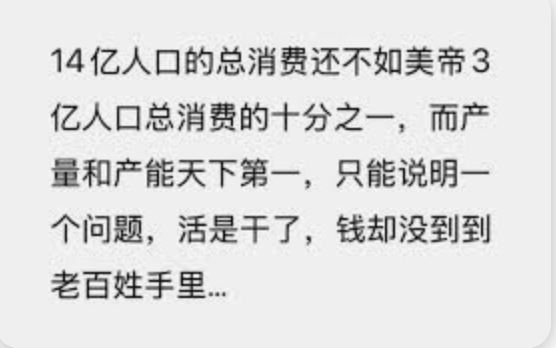
Notwithstanding its status as the world’s preeminent producer, China’s domestic consumption significantly trails that of the United States, prompting apprehensions regarding the sustainability of its economic model. Experts highlight a multifaceted interplay of elements, including income inequality, an export-oriented economic framework, and challenges associated with wealth distribution.
The fundamental concern pertains to income inequality. Although China serves as a manufacturing powerhouse, a substantial segment of the population lacks the disposable income necessary to stimulate domestic consumption to levels that are comparable to those in the United States.
China’s longstanding dependence on exports represents a significant factor in its economic framework. For several decades, the economic growth of the nation has been predominantly driven by the production of goods for international markets, consequently relegating domestic needs to a secondary position.
Moreover, the wealth produced by China’s swift economic growth may not be distributed equitably. A significant proportion is thought to be concentrated within a limited segment of the population or retained by state-owned enterprises.
The variations in social safety nets between China and the United States significantly contribute to the existing disparity. Given the possibility of elevated out-of-pocket expenses associated with healthcare, education, and retirement, it is conceivable that Chinese citizens may be compelled to save more, consequently resulting in a reduced amount of disposable income available for consumption.
Currency exchange rates and trade policies significantly contribute to the shaping of consumption patterns.
The situation poses essential inquiries regarding the long-term sustainability of China’s existing economic model. Experts indicate that policies fostering more equitable wealth distribution and enhanced domestic consumption are vital for ensuring future economic stability and elevating living standards for the wider populace. The government confronts the challenge of rebalancing the economy to more effectively meet the needs of its citizens while preserving its standing as a global economic leader.